Railway Group D is one of the most searched government job options among candidates looking for a stable career with Indian Railways. Along with job security, the Railway Group D Salary is an important factor that candidates consider before applying.
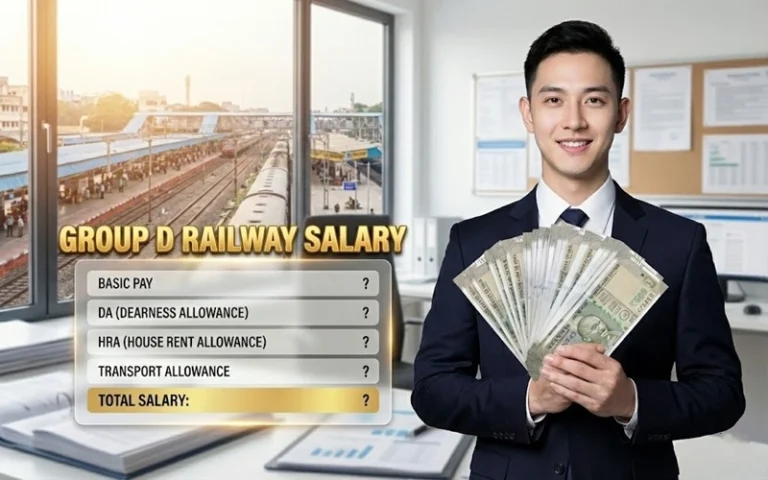
Under the current Level-1 recruitment framework, Railway Group D posts are placed in Level 1 of the 7th CPC Pay Matrix, with an initial basic pay of ₹18,000 per month. The actual monthly salary is higher after adding applicable allowances such as Dearness Allowance (DA), House Rent Allowance (HRA) and Transport Allowance. The amount received in the bank account is lower than gross salary because of deductions such as NPS and other applicable recoveries.
The exact Railway Group D in-hand salary can vary according to the posting location, admissible allowances, railway accommodation, deductions and the nature of duties. Therefore, candidates should not treat one fixed in-hand figure as applicable to every employee.
Railway Group D Salary 2026 – Quick Overview
| Particular | Details |
| Recruitment | RRB Level-1 / Group D |
| Pay Commission | 7th CPC |
| Pay Level | Level 1 |
| Initial Basic Pay | ₹18,000 |
| Pay Matrix | Level-1 Pay Matrix |
| Dearness Allowance | As applicable under Railway rules |
| HRA | Depends on city and eligibility |
| Transport Allowance | As applicable |
| Gross Salary | Basic Pay + applicable allowances |
| In-Hand Salary | Gross salary minus deductions |
| Major Deduction | NPS and other applicable recoveries |
| Increment | As per applicable pay rules |
Railway Group D Basic Salary and Pay Scale
The Railway Group D basic salary starts at ₹18,000 under Level 1 of the 7th CPC Pay Matrix. Basic pay is the foundation on which several salary components are calculated.
It is important to understand that ₹18,000 is not necessarily the amount that an employee receives in hand every month. Basic pay is only one component of the overall salary.
The monthly salary can include:
- Basic Pay
- Dearness Allowance
- House Rent Allowance
- Transport Allowance
- Duty-related allowances, wherever applicable
- Other admissible benefits
At the same time, deductions are made from gross earnings. These can include NPS contributions and other recoveries applicable to the employee.
Railway Group D Pay Matrix
| Pay Particular | Details |
| Pay Level | Level 1 |
| Initial Basic Pay | ₹18,000 |
| Pay Commission | 7th CPC |
| Pay Matrix | Level 1 |
| Annual Increment | As per applicable rules |
| Maximum Pay | Depends on progression through the pay matrix |
The Level-1 structure applies across various posts covered under the Railway Group D/Level-1 recruitment framework. The exact designation and duties may differ from one post to another, but the initial pay framework is based on Level 1.
Also read this: Pilot Salary in India | IBPS PO Salary | SSC CGL Salary | SSC CHSL Salary
Railway Group D Salary Per Month
The Railway Group D salary per month is made up of basic pay and applicable allowances. Therefore, the total monthly earnings can be considerably higher than the ₹18,000 starting basic pay. For example, an employee with a basic pay of ₹18,000 may receive DA, HRA and Transport Allowance depending on the applicable rules and posting.
The Department of Expenditure’s 2026 order increased the Central Government DA rate from 58% to 60% of basic pay with effect from January 1, 2026. However, the order itself notes that separate orders are issued for Railway employees, so Railway-specific salary calculations should follow the applicable Railway Board orders.
Railway Group D Monthly Salary Example
The following is an illustrative calculation, not a guaranteed payslip. Actual salary can vary according to Railway-specific rules, posting, HRA eligibility, accommodation and other allowances.
| Salary Component | Illustrative Amount |
| Basic Pay | ₹18,000 |
| DA | Depends on applicable Railway rate |
| HRA | Depends on city/eligibility |
| Transport Allowance | Depends on applicable rules |
| Other Allowances | If applicable |
| Gross Salary | Varies |
| Deductions | Varies |
| In-Hand Salary | Varies |
Railway Group D In-Hand Salary
The Railway Group D in-hand salary means the amount credited to an employee’s bank account after applicable deductions. A simple way to understand the calculation is:
In-Hand Salary = Basic Pay + Allowances – Deductions
For example, two employees may have the same ₹18,000 basic pay but receive different amounts because one may be eligible for higher HRA or certain duty-related allowances. Similarly, an employee occupying railway accommodation may have a different salary calculation from an employee receiving HRA.
Gross Salary vs In-Hand Salary
| Salary Term | Meaning |
| Basic Pay | Fixed pay according to the pay matrix |
| Gross Salary | Basic Pay + eligible allowances |
| Deductions | NPS and other applicable recoveries |
| In-Hand Salary | Amount remaining after deductions |
Railway Group D Salary Structure
The Railway Group D salary structure consists of several components. Some are common salary components, while others depend on the employee’s posting, duties and eligibility.
Basic Pay
Basic pay is the starting point of the salary calculation. For current Level-1 recruitment, the initial basic pay is ₹18,000. It also serves as a basis for calculating several other components, including DA and, where applicable, HRA.
Dearness Allowance (DA)
DA is paid to compensate employees partly for changes in the cost of living. The Department of Expenditure announced a DA rate of 60% of basic pay for Central Government employees from January 1, 2026. Railway employees are governed by Railway-specific orders, so candidates should check the latest Railway Board order applicable at the time of appointment.
House Rent Allowance (HRA)
HRA is linked to the employee’s place of posting and eligibility. Under the 7th CPC framework, HRA rates are linked to city classification, with rates moving upward when DA crosses specified thresholds. The Department of Expenditure’s HRA framework provides the X, Y and Z city structure. Railway employees may also be provided railway accommodation where available and applicable. In such situations, the salary treatment can differ from an employee receiving HRA.
Transport Allowance (TA)
Transport Allowance is intended to meet commuting-related expenses where admissible. The Department of Expenditure maintains separate instructions covering Transport Allowance for eligible Central Government employees. Railway-specific implementation should be checked under applicable Railway rules.
Other Allowances
Depending on the post and nature of duty, employees may receive additional allowances or benefits. These can include duty-related, night-duty, overtime or other admissible payments. Such allowances should not be assumed for every Group D employee because eligibility can depend on the post and actual duties.
Railway Group D Allowances and Benefits
| Allowance/Benefit | Purpose |
| Dearness Allowance | Helps compensate for inflation |
| HRA | Housing-related support where admissible |
| Transport Allowance | Commuting-related allowance where applicable |
| Night Duty Allowance | Applicable for eligible duties |
| Overtime Benefits | Applicable for eligible extra duty |
| Railway Accommodation | Subject to availability and rules |
| Medical Benefits | Available under applicable Railway facilities |
| Travel/Pass Benefits | Subject to applicable Railway rules |
Railway Group D Salary After Deductions
A Railway Group D employee does not receive the complete gross salary as take-home pay. One of the important deductions for employees covered under the National Pension System is the employee contribution toward NPS. Other deductions may also apply depending on the employee’s circumstances.
Common deductions can include:
- NPS contribution
- Income tax, if applicable
- Railway accommodation-related recovery, where applicable
- Insurance or other authorized deductions
- Other departmental recoveries, if applicable
How Salary Deductions Affect In-Hand Pay
Suppose the gross salary is ₹X and total deductions are ₹Y.
In-Hand Salary = ₹X – ₹Y
This is why the salary shown in a recruitment advertisement should not automatically be treated as the amount credited to the employee’s account.
Railway Group D Salary During Probation
Newly appointed employees undergo the applicable initial service/probation requirements prescribed for their post and recruitment rules. During this period, employees receive salary and applicable benefits according to the relevant Railway service rules. The exact treatment of allowances can depend on the employee’s post, place of posting and applicable regulations.
Candidates should be cautious about websites claiming that every Group D employee receives a completely different “probation salary.” The recruitment notification and applicable Railway rules are the better sources for determining the actual pay structure.
Railway Group D Post-Wise Salary
Railway Group D is commonly used as a broad term for Level-1 posts. Different posts can involve different responsibilities even when they fall under the same pay level.
| Post | Pay Level | Initial Basic Pay | Salary Framework |
| Track Maintainer | Level 1 | ₹18,000 | Level-1 + applicable allowances |
| Pointsman | Level 1 | ₹18,000 | Level-1 + applicable allowances |
| Assistant | Level 1 | ₹18,000 | Level-1 + applicable allowances |
| Assistant Workshop | Level 1 | ₹18,000 | Level-1 + applicable allowances |
| Assistant Loco Shed | Level 1 | ₹18,000 | Level-1 + applicable allowances |
| Assistant Operations | Level 1 | ₹18,000 | Level-1 + applicable allowances |
Railway Group D Salary: City-Wise Difference
Posting location can have a significant effect on the salary received by an employee. One major reason is HRA. Under the 7th CPC HRA framework, cities are classified into X, Y and Z categories. The applicable HRA rate depends on the classification and the prevailing conditions under the rules. For example, the 7th CPC framework provides for HRA rates of 30%, 20% and 10% of basic pay when the relevant DA threshold reaches 50%, for X, Y and Z cities respectively.
City Classification and HRA
| City Category | HRA Framework* |
| X | 30% |
| Y | 20% |
| Z | 10% |
*Applicable rate depends on the prevailing government rules and conditions. At a basic pay of ₹18,000, these percentages would correspond to ₹5,400, ₹3,600 and ₹1,800 respectively as an illustration. However, employees should not assume that these amounts will automatically be added to every Railway salary because accommodation, eligibility and Railway-specific rules can affect the actual payment.
Railway Group D Salary Increment
The salary does not remain fixed at ₹18,000 throughout an employee’s career. Employees progress through the pay matrix through applicable annual increments and may also receive higher pay following promotion or financial progression under applicable service rules. An increment increases basic pay to the next applicable stage in the pay matrix. Since DA and some other components are linked to basic pay, an increase in basic pay can also affect the overall salary.
Factors That Can Increase Monthly Earnings
- Annual increment
- DA revisions
- Change in HRA rates
- Promotion
- Financial progression
- Eligible duty-related allowances
- Overtime or other admissible payments
Railway Group D Salary After 5 Years
Candidates often search for Railway Group D salary after 5 years because they want to know how much their income can increase after joining. There is no single guaranteed five-year salary figure because an employee’s salary after five years depends on the starting pay, annual increments, DA revisions, promotions, posting and other applicable components.
A simplified progression can be understood as:
Joining → Annual Increments → DA Changes → Possible Promotion/Financial Progression → Higher Salary
Therefore, the salary after five years should be calculated using the applicable pay-matrix stages rather than multiplying the starting salary by a fixed percentage.
Railway Group D Salary After 10 Years
The same principle applies to the Railway Group D salary after 10 years.
An employee who remains in service for a decade may have a significantly different basic pay and allowance structure compared with the starting year. However, the exact figure depends on:
- Number of increments received
- Pay-matrix progression
- DA revisions
- HRA
- Posting location
- Promotion
- Financial progression
- Applicable deductions
Railway Group D Promotion and Career Growth
Railway Group D/Level 1 employment can provide opportunities for career progression within the railway system. Employees can become eligible for advancement through the applicable departmental selection, seniority, promotion and financial progression mechanisms, depending on the post and Railway rules.
Railway Group D Career Progression
Level-1 Appointment → Annual Increments → Departmental/Promotional Opportunities → Higher Pay Level
The exact promotional route is not identical for every Level-1 employee. It depends on the department, post, vacancies, eligibility criteria and applicable Railway Board rules.
The Railway Board also maintains instructions related to pay fixation and career progression under the applicable service framework.
Railway Group D Salary vs Other Railway Posts
| Post | Pay Structure | Main Difference |
| Group D / Level 1 | Level 1 | Entry-level Railway roles |
| Technician | Depends on notified post | Technical responsibilities |
| Assistant Loco Pilot | Higher pay structure | Running and technical duties |
| Junior Engineer | Higher pay level | Supervisory/technical responsibilities |
A direct salary comparison should always be made using the latest recruitment notification because pay levels, allowances and eligibility requirements can change between recruitment cycles.
Railway Group D Salary Slip
A salary slip provides a detailed record of monthly earnings and deductions.
A typical salary slip can contain:
| Salary Slip Section | What It Shows |
| Basic Pay | Basic monthly pay |
| DA | Dearness Allowance |
| HRA | House Rent Allowance, if admissible |
| TA | Transport Allowance, if admissible |
| Other Earnings | Other eligible payments |
| Gross Earnings | Total earnings before deductions |
| NPS | Pension contribution |
| Other Deductions | Applicable recoveries |
| Net Pay | Amount payable after deductions |
Railway Group D Salary and Job Benefits
Salary is only one part of the overall compensation package. Railway employees may receive various employment-related facilities under applicable Railway rules, including medical facilities, leave benefits, retirement-related benefits and travel-related concessions.
The exact benefits depend on the employee’s status, post and applicable Railway regulations.
Important Benefits
- Railway medical facilities
- Leave benefits
- NPS/retirement-related benefits
- Railway travel-related facilities
- Railway accommodation, where available
- Allowances linked to eligible duties
- Career progression opportunities
Is Railway Group D Salary Good for Freshers?
For candidates entering government service, the most important point is to understand the complete compensation rather than focusing only on basic pay. The starting basic pay of ₹18,000 is supplemented by applicable allowances, while deductions reduce the final take-home amount. Over time, annual increments, DA revisions and career progression can change the overall salary. The job also provides access to the broader benefits and service framework available to eligible Railway employees.
Conclusion
The Railway Group D Salary 2026 structure starts with an initial basic pay of ₹18,000 under Level 1 of the 7th CPC Pay Matrix. However, the amount an employee actually receives is determined by much more than basic pay. DA, HRA, Transport Allowance, duty-related payments and deductions all influence the final salary. The Railway Group D in-hand salary can differ between employees because posting location, accommodation, allowances and deductions are not necessarily identical. This is why candidates should avoid relying on a single fixed salary figure published on unofficial websites.
For long-term career growth, annual increments, DA revisions, promotion opportunities and applicable financial progression can gradually increase the employee’s earnings. Candidates preparing for RRB Level-1 recruitment should always verify the latest notification and Railway Board orders before calculating their expected salary.
FAQs
1.What is Railway Group D salary in 2026?
The current Level-1 recruitment framework specifies an initial basic pay of ₹18,000 per month under the 7th CPC Pay Matrix. The final monthly salary is higher after applicable allowances and lower after deductions.
2.What is Railway Group D salary per month?
Railway Group D monthly earnings depend on basic pay, DA, HRA, Transport Allowance and other eligible components. Therefore, there is no single in-hand figure applicable to every employee.
3.What is Railway Group D in-hand salary?
Railway Group D in-hand salary is the amount credited after adding eligible salary components and deducting NPS and other applicable recoveries. It varies according to posting and individual salary conditions.
4.What is the basic salary of Railway Group D?
The initial basic pay for the current Level-1 recruitment framework is ₹18,000 per month.
5.What is Railway Group D pay level?
Railway Group D posts under the current Level-1 recruitment framework are placed in Level 1 of the 7th CPC Pay Matrix.
6.Does Railway Group D get DA?
Yes, DA is an applicable component of the salary structure. The exact rate for Railway employees should be checked against the latest Railway Board order. The Department of Expenditure’s January 2026 Central Government order set the DA rate at 60%, while noting that separate orders apply to Railway personnel.