
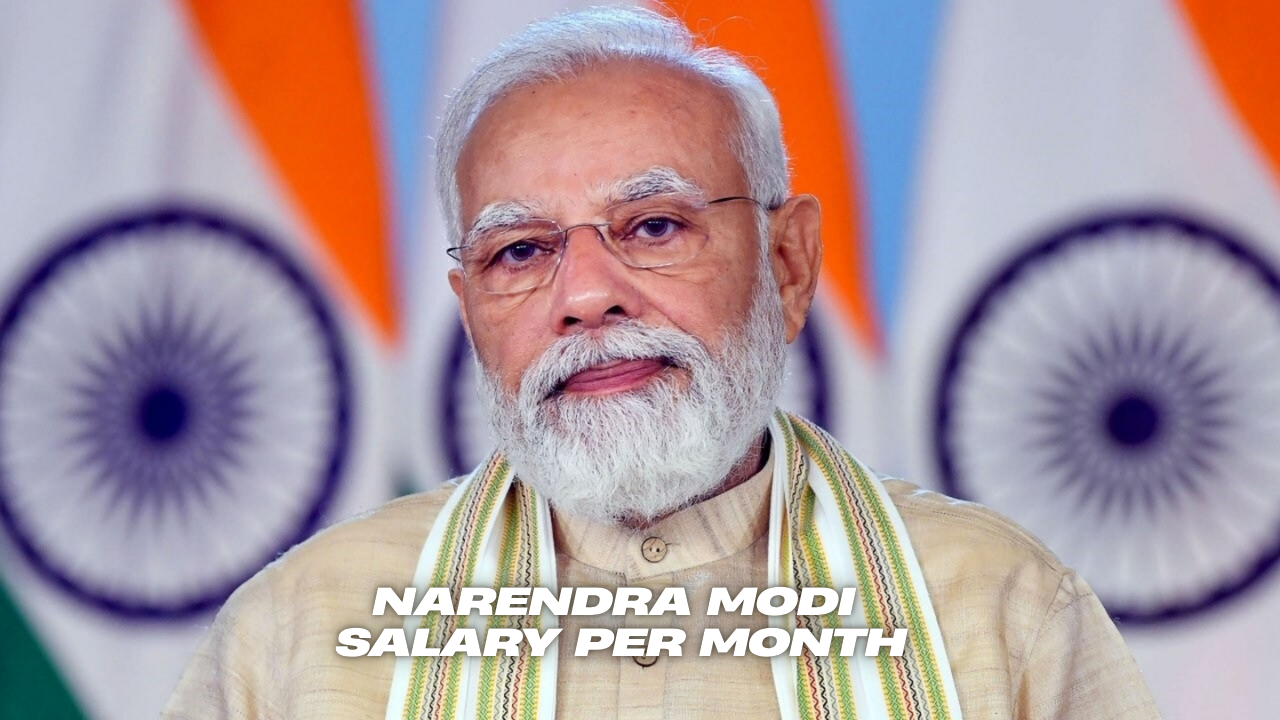
Narendra Modi is the current Prime Minister of India, as well as a leading figure in Indian politics. There is a lot of curiosity about what he receives in terms of salary, other official benefits and his total declared wealth. Many people want to find out how much the head of the Indian government gets paid.
Narendra Modi Salary Per Month represents an individual’s earnings during a specific timeframe, whereas official accommodations, transportation, and security provided by the government do not constitute personal income. Therefore, it is important to understand the Narendra Modi salary per month in 2026 based upon the remuneration rules that apply to the Prime Minister as well as the Prime Minister’s entitlement to other official amenities.
This article explains the Prime Minister of India’s pay structure, yearly income, allowances, job-related benefits and publicly available asset declarations. Please verify these figures with the most current official records prior to assuming they are accurate for 2026.
Narendra Modi Salary Per Month 2026
The Prime Minister’s remuneration is determined by the relevant rules and regulations governing parliamentary pay and allowances. Narendra Modi is the head of the Union government, but his salary does not represent the full budget allocated to the Prime Minister’s Office nor does it reflect the cost of providing him with the necessary facilities to carry out his official duties.
The first thing you want to do is to determine if your source provides an annual wage or if it provides a monthly wage. You also want to make sure that the figure provided includes all of your eligible benefits such as daily allowances, etc. Lastly, you will want to verify the effective date of the most current rate since figures in older sources are not likely to accurately represent the current rates.
Narendra Modi Salary Overview 2026
Narendra Modi’s salary as Prime Minister of India includes a monthly salary component and applicable allowances. The following table uses the revised statutory rates effective from 1 April 2023.
| Salary Detail | Amount in 2026 |
| Name | Narendra Modi |
| Current Position | Prime Minister of India |
| Monthly Salary | ₹1,24,000 |
| Annual Salary Component | ₹14,88,000 |
| Daily Allowance | ₹2,500 per eligible day |
| Constituency Allowance | ₹87,000 per month |
| Prime Minister’s Sumptuary Allowance | ₹3,000 per month |
| Official Residence | Government-provided |
| Official Transport and Security | Provided for official duties |
Narendra Modi Annual Salary in 2026
Narendra Modi’s annual salary can be calculated by multiplying the applicable monthly salary by 12, provided the monthly rate remains unchanged throughout the year.
Narendra Modi Annual Salary Breakdown
| Salary Component | Monthly Amount | Annual Amount |
| Basic salary component | ₹1,24,000 | ₹14,88,000 |
| Constituency allowance | ₹87,000 | ₹10,44,000 |
| Sumptuary allowance | ₹3,000 | ₹36,000 |
| Daily allowance | ₹2,500 per eligible day | Depends on eligible days |
| Fixed components subtotal | ₹2,14,000 | ₹25,68,000 |
Also read this: Neha Bora Biography | Ashutosh Ranka Salary | Abhijeet Dipke Income Source
Narendra Modi Salary Breakdown: Basic Pay and Allowances
Narendra Modi’s remuneration as Prime Minister of India is governed by the Salaries and Allowances of Ministers Act, 1952, along with applicable rules. The Act links a minister’s salary, daily allowance and constituency allowance to the relevant rates for Members of Parliament.
Basic Salary of the Indian Prime Minister
The monthly salary component is ₹1,24,000 under the parliamentary salary rate effective from 1 April 2023. This equals ₹14,88,000 annually if the rate remains unchanged for 12 months.
Daily Allowance and Other Eligible Allowances
The following table summarizes the relevant components and their applicable rates.
| Salary Component | Amount | Payment Basis |
| Monthly salary | ₹1,24,000 | Per month |
| Constituency allowance | ₹87,000 | Per month |
| Daily allowance | ₹2,500 | Per eligible day |
| Sumptuary allowance | ₹3,000 | Per month |
| Annual salary component | ₹14,88,000 | Annualized monthly salary |
What Benefits Does Narendra Modi Receive as Prime Minister?
Apart from monetary remuneration, the Prime Minister receives official facilities needed to carry out government responsibilities. These facilities support the functioning of the office and should not be confused with personal earnings.
Official Residence
The official residence for the Prime Minister of India is located in New Delhi. It provides support for both official functions as well as the daily duties of the position.
The cost of having a government-provided home does not represent cash directly given to the prime minister. As per the Salaries and Allowances of Ministers Act, 1952, ministers have a right to live in a government-provided house that has furniture in it without paying rent, so long as they meet the required conditions.
Official Transport and Security
The Prime Minister has a range of official responsibilities that require him/her to make trips within Australia, abroad and attend high level meetings. To assist with his/her official responsibilities, official transport and security will be arranged.
These are all part of the Prime Minister’s office and are not personal salaries, nor are they considered to be part of the wealth that Narendra Modi owns.
Travel and Administrative Support
The official travel, support staff, and administrative assistance provided to the prime minister assist in his/her performance of government-related functions. Travel and meal allowance policies are set by the appropriate governing authorities; these policies vary based upon the specific nature of each official function performed.
These facilities need to be considered individually as part of the overall compensation package.
Narendra Modi Net Worth 2026 and Declared Assets
Narendra Modi net worth is a highly searched subject for many readers, especially those who want to know about how much money he makes, how much money he saves, where he invests, and what he owns. Based on information provided by the Prime Minister’s Office (PMO), Narendra Modi’s total reported net worth as of March 31, 2026 was ₹4,01,60,999 (around ₹4.02 crore). The source of this data is from the official reporting of assets and liabilities for the 2025-2026 fiscal year.
It is essential to make a distinction between the asset declaration made by a politician and their actual net worth. The amount of ₹4.02 crore is the total value of all declared movable assets of the Prime Minister and does not include an assessment of his entire earnings from his time in politics. Additionally, his salary as Prime Minister, personal savings and any government provided amenities are categorized separately.
Narendra Modi’s Declared Assets in 2026
The PMO’s most recent disclosure has revealed the details of Mr. Modi’s bank accounts, savings certificates, cash and gold jewelry. The data listed above represents a summary of what was disclosed by the PMO.
| Asset Category | Declared Value |
| SBI fixed deposits and MOD deposits | ₹3,79,76,101 |
| National Savings Certificates (NSC) | ₹10,24,724 |
| Bank account balance | ₹3,562 |
| Cash in hand | ₹34,429 |
| Gold jewellery (four rings) | ₹4,58,864 |
| Total declared movable assets | ₹4,01,60,999 |
Narendra Modi Salary Compared with Other Indian Leaders
The salaries of India’s top constitutional and political leaders vary according to the laws governing their respective offices. The following table compares their monthly salary figures and clarifies the differences in remuneration.
| Indian Leader | Monthly Salary | Annualized Salary |
| President of India | ₹5,00,000 | ₹60,00,000 |
| Vice President of India | ₹4,00,000* | ₹48,00,000* |
| Narendra Modi (Prime Minister) | ₹1,24,000** | ₹14,88,000** |
| Member of Parliament (MP) | ₹1,24,000 | ₹14,88,000 |
| Chief Minister of a state | Varies by state | Varies by state |
Has Narendra Modi Salary Increased Over the Years
For instance, the Gazette notice published in 2025 related to MPs confirmed that the updated rates will be applicable starting on April 1st, 2023. The Gazette notice also stated that the MP’s monthly salary would be Rs 1,24,000, which is an increase from the previous monthly salary of Rs 1,00,000.
| Period | Monthly Parliamentary Salary Component | Prime Minister’s Sumptuary Allowance | Key Change |
| Before May 2009 | ₹16,000 | Verify historical rate | Earlier salary structure |
| May 2009–March 2018 | ₹50,000 | ₹3,000 | Parliamentary salary revised |
| April 2018–March 2020 | ₹1,00,000 | ₹3,000 | Salary increased |
| April 2020–March 2021 | ₹70,000 | ₹2,100 | Temporary COVID-19 reduction |
| April 2021–March 2023 | ₹1,00,000 | ₹3,000 | Earlier rates restored |
| April 2023–2026 | ₹1,24,000 | ₹3,000 | Parliamentary salary rate revised |
Conclusion
Narendra Modi Salary per month 2026 includes much more than just a number. It is important to separate each part of his compensation, which includes his monetary salary, applicable benefits, use of government provided services and personal assets.
To determine exactly how much the Prime Minister of India earns each month and year in wages, it is first necessary to establish what is the applicable ministerial wage regulation and when it became effective. Any money earned by the Prime Minister for official housing, travel, or protection does not constitute personal cash income; however, any of the Prime Minister’s declared assets will need to be evaluated based on the most recent financial disclosures.
Using official government documents and clearly dated information enhances the credibility, usefulness to readers and suitability for searches concerning Prime Minister Modi’s salary, annual income, and financial disclosures of this article.
FAQs
1. What is Narendra Modi salary per month in 2026?
Narendra Modi’s remuneration as Prime Minister is governed by the applicable ministerial salary and allowance rules. A precise consolidated monthly total should be verified against the latest applicable official provisions. Some secondary websites quote approximately ₹1.66 lakh per month, but that figure should not be treated as an independently confirmed official total without supporting documentation.
2. What is Narendra Modi’s annual salary?
Annual salary can be calculated by multiplying the applicable monthly salary by 12 if the rate remains unchanged throughout the year. Additional allowances should be included only when their eligibility and amounts have been verified.
3. How much does the Prime Minister of India earn per day?
A daily equivalent can be estimated by dividing an annualized salary by 365, but this is only a mathematical average. It is not the same as an official daily allowance or the amount actually paid for each working day.
4. Does Narendra Modi receive allowances apart from his salary?
Ministerial remuneration may include allowances and entitlements governed by applicable legislation and rules. The amount depends on the specific provision, and not every allowance should automatically be treated as a fixed monthly payment.
5. Does the Prime Minister receive an official residence?
Yes. The Prime Minister is provided with official residential arrangements for carrying out the responsibilities of the office. Such accommodation is an official facility, not automatically personal income or a personally owned property.
6. What is Narendra Modi’s declared net worth?
His declared assets and liabilities can be reviewed through the official PM India website. The latest disclosure listed for 2025–2026 is dated 31 March 2026. Readers should use that declaration for current figures instead of relying on estimates without a clear reporting date.
7. Is Narendra Modi’s salary different from an MP’s salary?
The remuneration rules for ministers and MPs are related but not identical in every respect. The Salaries and Allowances of Ministers Act, 1952 contains provisions for ministers, including a restriction on receiving an additional parliamentary salary or allowance under Section 9.
8. Where can readers verify the Prime Minister’s salary?
Readers can consult the official India Code legislation portal, the Prime Minister of India’s website and relevant Gazette notifications published by the Government of India. These sources help establish the applicable rules and distinguish official disclosures from secondary estimates.